Publised on May 17, 2026
From Desalination Dependency to Water Resilience Architecture

Felix Schaller
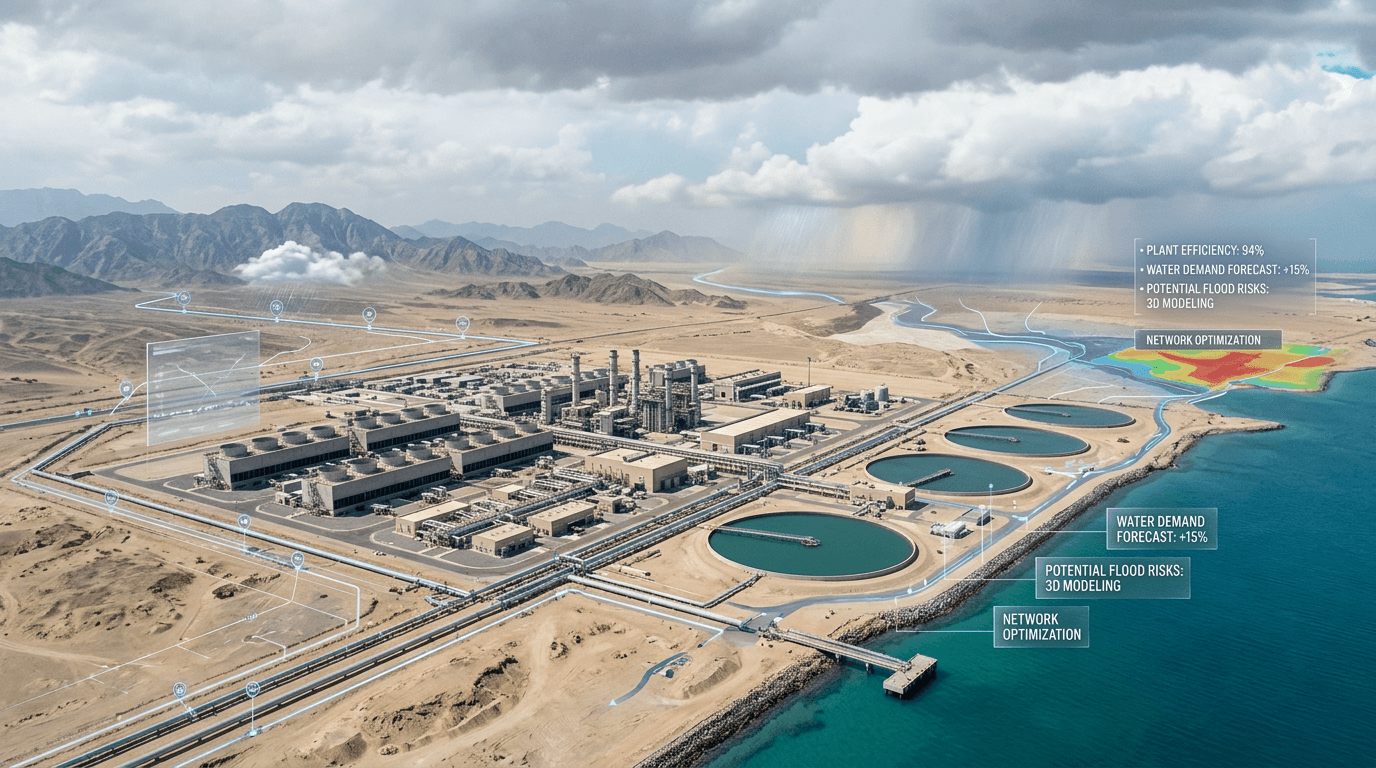
The Gulf region depends heavily on desalination. That dependency has enabled modern cities, industrial growth, and high living standards in some of the most arid environments on Earth. But it also creates a structural vulnerability. Desalination plants are not just water-production assets. In the Gulf, they are civilization-support infrastructure, tightly coupled to energy systems, coastal facilities, pipelines, storage, logistics, and emergency response.
In a new whitepaper, I examine why Gulf water security should not be treated as a desalination-capacity problem alone, but as a resilience architecture problem.
Why this topic matters
Public discussions around desalination infrastructure often focus on capacity, efficiency, or cost per cubic meter. Those are important metrics. But they are not enough. A highly optimized water-production system can still be fragile if it depends on a small number of centralized coastal plants, continuous power availability, intact pipelines, functioning intake systems, chemical supply chains, and stable emergency logistics. From an engineering perspective, this is a classic system-of-systems problem.
The key question is not only:
How much water can be produced?
The deeper question is:
What happens when one or more critical layers fail?
Beyond desalination: the water resilience stack
The whitepaper proposes a layered approach to Gulf water security. Instead of relying on desalination as a single dominant layer, water resilience should combine:
hardened desalination infrastructure
distributed freshwater reserves
emergency routing and pumping redundancy
rainfall and flood capture
wadi dams and retention basins
managed aquifer recharge
atmospheric water harvesting
cloud seeding and weather-modification governance
hydrological digital twins
demand-side resilience
The goal is not to replace desalination. The goal is to prevent desalination from becoming a single point of failure.
Atmospheric water: not absent, but hard to capture
A central argument of the paper is that desert environments are often misunderstood. The desert is not simply “without water”. Water appears irregularly, locally, and often violently — as dew, fog, virga, flash floods, short seasonal rainfall, and atmospheric moisture distributed across temperature layers.
This distinction matters.
Warm air can carry significantly more water vapor than cold air. As air cools, its saturation threshold drops, which can lead to condensation. This is one of the physical foundations behind atmospheric water recovery and cloud-seeding concepts. But condensation alone is not water security.
The full chain matters:
atmospheric moisture → nucleation → droplet growth → precipitation survival → surface capture → storage
If rain evaporates before reaching the ground, it becomes virga.
If rain reaches the ground but is not captured, it becomes runoff.
If runoff is not stored, it becomes lost freshwater.
Why digital twins matter
Digital twins play a central role in the proposed architecture. A water-resilience digital twin can connect:
weather forecasts
radar and satellite data
desalination capacity
storage levels
pipeline constraints
wadi runoff behavior
aquifer recharge potential
emergency demand scenarios
infrastructure outage simulations
This turns isolated water technologies into an adaptive system. Without such a control layer, desalination, cloud seeding, flood capture, aquifer recharge, and emergency storage remain separate initiatives. With a digital twin, they become part of one decision architecture.
Geoengineering needs governance
The paper also discusses cloud seeding and dry-ice-induced glaciogenic seeding concepts. The core argument is deliberately cautious:
Dry ice can locally cool humid air and trigger condensation or ice formation under suitable conditions. But creating condensation is not the same as creating usable rainfall.
The difficult scientific and engineering question is whether artificial cold-source seeding can create precipitation-sized hydrometeors that survive the fall through hot, dry air and become captured water.
This makes governance essential. Weather modification without monitoring, hydrological planning, and public transparency can itself become a risk layer.
Conclusion
The Gulf does not need one more isolated water technology. It needs a water resilience architecture. Desalination will remain indispensable. But long-term water security requires a broader system: production, capture, storage, routing, digital simulation, governance, and emergency planning. That is the DeepTech opportunity. Not artificial rain on demand. But robust water systems under uncertainty.
Read the whitepaper
From Desalination Dependency to Water Resilience Architecture
A DeepTech perspective on critical water infrastructure, atmospheric engineering, and resilience planning in the Gulf