Publised on Jun 28, 2026
Gödel Is Not a Death Sentence for Reason

Felix Schaller

Gödel’s incompleteness theorem is not a death sentence for reason.
It is a 90-year misdiagnosis — and the same misdiagnosis sits inside every Large Language Model used today.
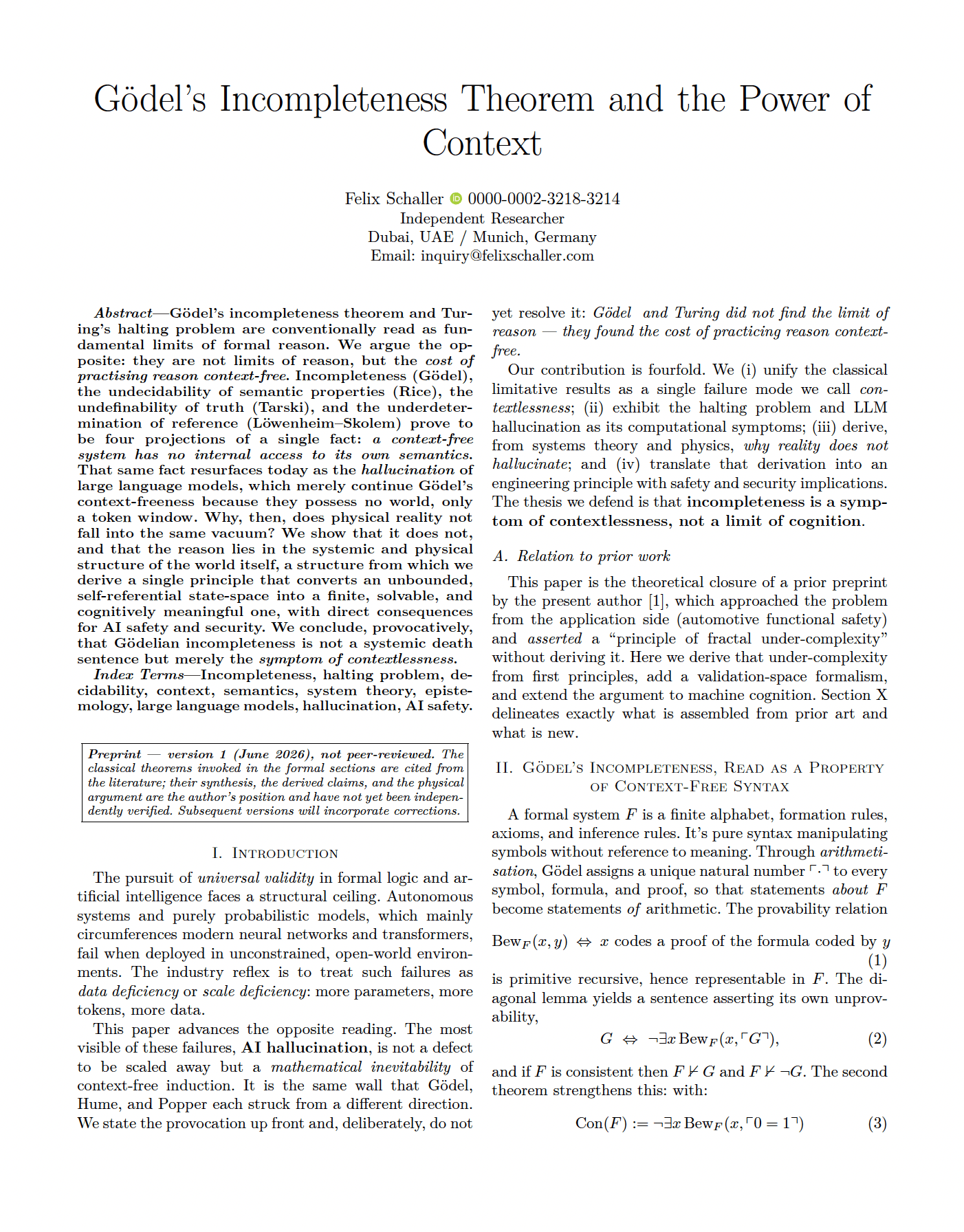
This article discusses my new Zenodo paper: 🔗 read it here 👈
The same pathology inside modern AI
Modern AI is a giant induction machine. It generalizes from a finite pile of training data to a universal claim about whatever the user asks next. That move is powerful, commercially useful, and structurally incomplete.
Hume showed in 1748 why induction cannot logically guarantee the next case. Gödel showed in 1931 why no sufficiently expressive system can verify itself completely from the inside. When a model hallucinates, it is not merely failing because of insufficient data. It is exposing the architecture’s own boundary condition.
You cannot scale your way out of a categorical gap. More data is just a bigger dose of a medicine that does not treat the disease.
The missing term is context
The pathology was never in the theorem itself. It was in the assumption that a theorem, an algorithm, or a model could ever stand without a context. Incompleteness, the halting problem, and AI hallucination are not isolated problems. They are different faces of one missing term: context.
A context-free machine is forced to operate in an unbounded logical space. In that space, every next statement can always exceed the system’s internal ability to prove, halt, classify, or verify itself. The machine does not merely lack knowledge. It lacks a boundary.
Physics finally bounds the problem
The way out is not philosophical optimism. It is physics. Physical reality is undercomplex compared with an unbounded logical space. Objects have mass. Motion is continuous. Causality is local. Energy, geometry, and time constrain what can happen next.
That means Gödelian incompleteness is not a systemic death sentence. It is the symptom of contextlessness. Once the system is grounded in a physically bounded operating context, the space of possible behaviours becomes constrained enough to reason about, validate, and govern.
What this means for AI hallucination
Hallucination is not simply a bug to engineer away. It is what context-free machines do when asked to produce certainty outside their grounded domain. If the system has no formal boundary for what a statement means, where it applies, and how it can be verified, it will fill the gap probabilistically.
The question is therefore not whether hallucination can be reduced. It can. The deeper question is whether hallucination is a permanent feature of machines that operate without a defined context. My answer is yes.
Reason survives Gödel. But only when it stops pretending that formal systems, algorithms, or AI models can stand nowhere and mean everything.
Read the Zenodo paper: 🔗 Gödel, Context, and AI Hallucination 👈