Publised on Jun 12, 2026
Why True Autonomous Driving Requires More Than Perception

Felix Schaller

Most autonomous systems today are sophisticated snapshot machines. They perceive the world in the moment — and then forget it.
That is not how safe autonomy works.
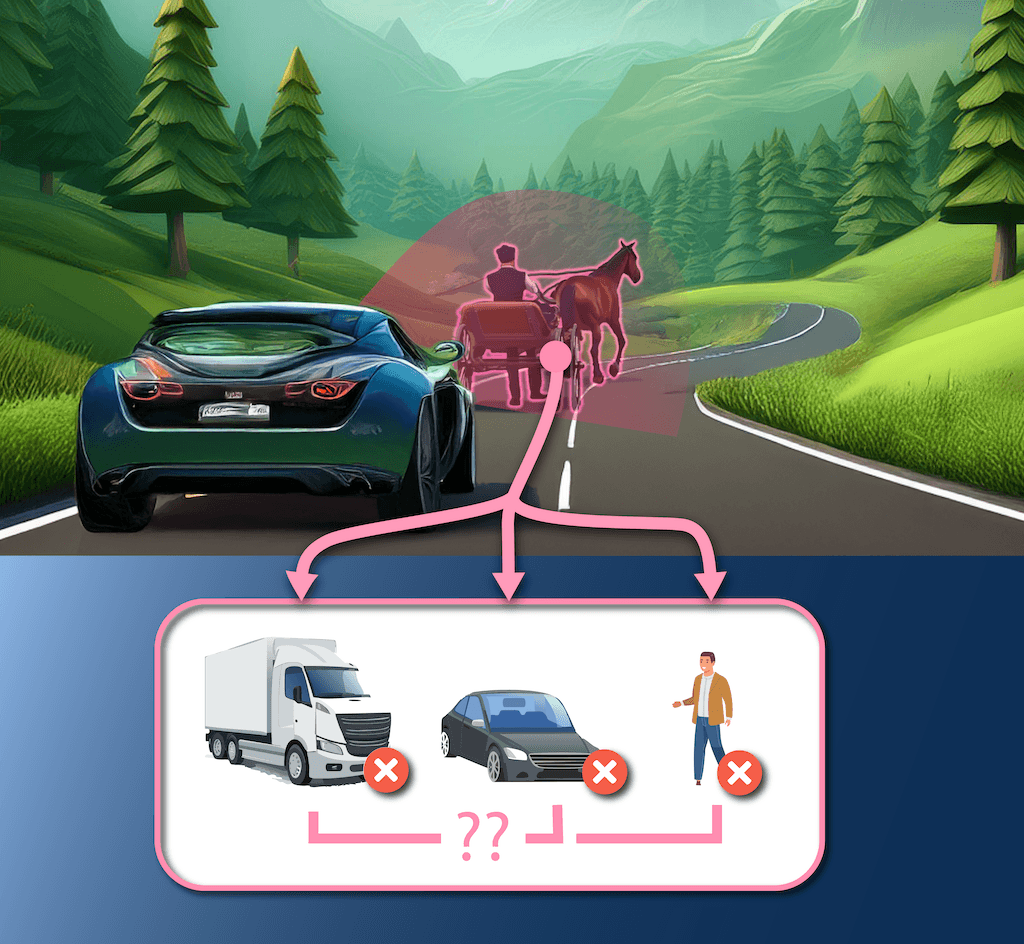
A child disappears behind a parked car. Physically, the child still exists. Mass is conserved. The child could step onto the road at any moment. A system that only processes what it currently sees has already failed — not because of bad perception, but because it has no world model.
Three problems that pure computer vision cannot solve alone
Physical constraints are not enforced. Objects do not vanish. A pedestrian behind an obstruction is still there. Yet most systems treat occlusion as absence and reset at every frame.
Semantics requires taxonomy, not just recognition. A person on a billboard is not a pedestrian. A cyclist who ran a red light three seconds ago is a higher-risk object than one who did not. True semantic understanding means contextual classification — knowing what something is and what it implies. Semantic segmentation is not semantics.
Prediction requires simulation, not just detection. Safe autonomy means projecting from the past into the future. Tracking objects over time. Anticipating where things will be, not just where they are. A cyclist behaving erratically at an intersection is a signal. These are not edge cases — they are the scenarios where snapshot systems fail and people get hurt.
The architecture that actually solves this
The solution is not a better neural network. It is a hybrid system: neural perception for recognition, formal world modeling for continuity, semantic taxonomy for context, and physics-constrained simulation for prediction.
A coherent virtual simulation layer is not an optional test infrastructure. It is a core architectural requirement. The system must be able to project its world model forward in time — simulating where every tracked object will be, under what physical constraints, with what behavioural uncertainty — before committing to any action in the real world.
Without that layer, the system is not predicting. It is reacting. And in safety-critical domains, reaction latency at speed is not a margin, but it is a failure mode.
We have been publishing about this. Here are some excerpts:
🔗 https://doi.org/10.5281/zenodo.20562409 👈
🔗 https://doi.org/10.3233/AISE250023 👈
The conversation the industry needs to have
Most teams underestimate this architecture challenge until it is too late. The gap between a perception stack that performs well on benchmarks and a system that can safely navigate an occluded intersection at 50 km/h is not a training data problem. It is a structural one.
If you are building in autonomous systems, ADAS, robotics, or regulated AI and need an experienced technical partner to stress-test your architecture, identify validation gaps, or provide fractional CTO-level guidance — this is exactly what we do at FelixSchallerCOM.