Publised on Jun 9, 2026
We Are Shipping More AI Than Ever. That Does Not Mean We Are Creating More Value.

Felix Schaller
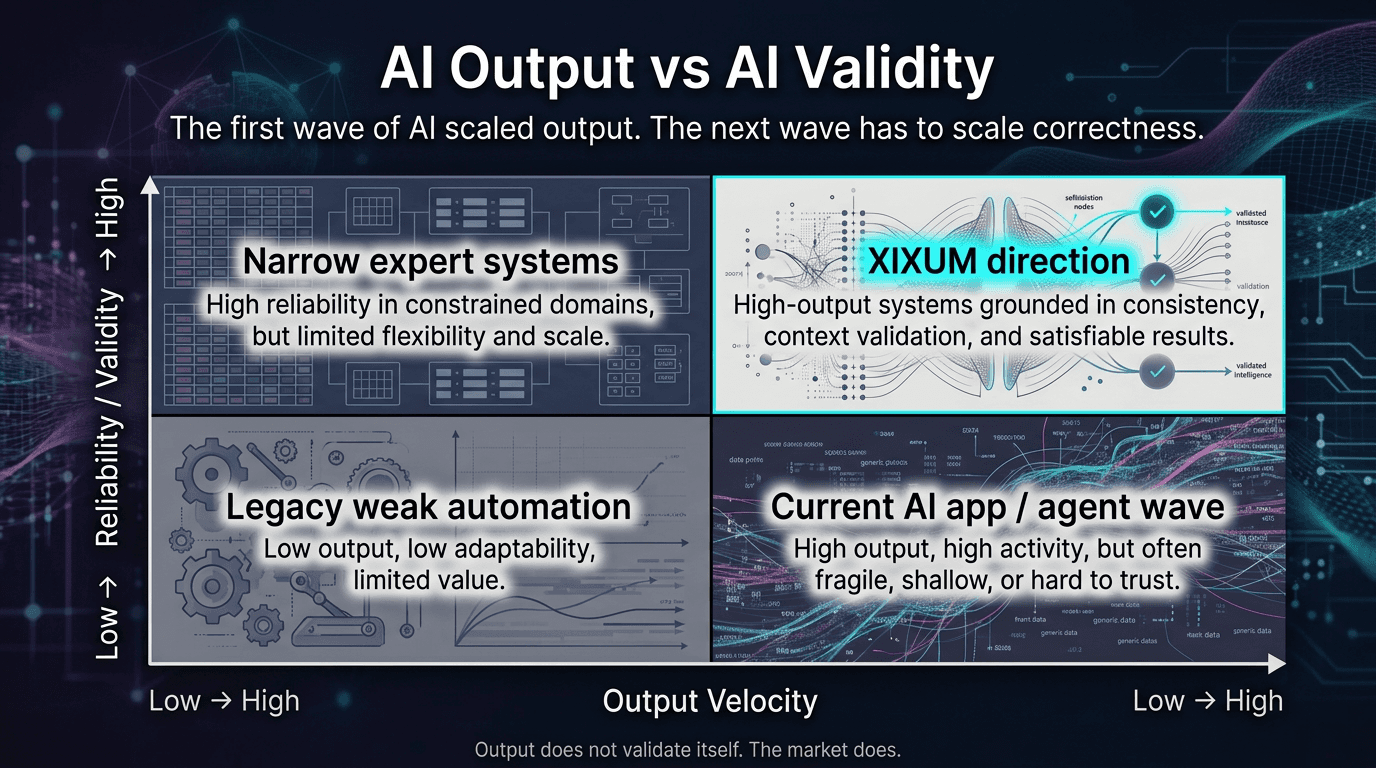
We are shipping more AI than ever. That does not mean we are creating more value.
One of the clearest signals I have seen recently came from Michael Spencer: AI app launches are accelerating fast, but usage and reviews are not keeping up at the same pace. That gap matters. It suggests something simple but important: the industry has become very good at producing output, but output does not validate itself. The market does.
This is the pattern I think we are now starting to see more clearly. More AI apps does not automatically mean more utility. More agents does not automatically mean more adoption. More generated output does not automatically mean a better business. It just means the system is capable of producing more.
The real bottleneck is shifting
For the last wave of AI, the core question was: can the machine generate something useful? That question has mostly been answered. Yes, it can. It can write, summarize, code, automate, and increasingly act.
But once a system starts entering real workflows, a different bottleneck appears. The question is no longer only whether it can produce an answer. The question becomes whether the answer actually holds up. Is it consistent? Does it fit the context? Can it be trusted? Does it create value, or does it just move complexity into another layer?
A lot of current AI products are running into exactly that wall. They make some things faster, but they often introduce new tradeoffs: fragile automation pipelines, higher token costs, more debugging, more exceptions, more maintenance, and new forms of operational overhead. The problem was not removed. It was displaced.
This is exactly where XIXUM sits
This question is not abstract for me. It comes directly out of my consulting work in autonomy and software safety. Evaluating architectures under ISO 26262 and SOTIF constraints means asking one thing constantly: not whether a system can produce an output, but whether that output is actually valid within a defined operational context. Whether it is consistent. Whether it can be traced, audited, and trusted when it matters.
XIXUM is the answer I built to that problem. It is a deductive AI system developed as a direct product of this consulting practice, designed for exactly the layer where probabilistic output is not enough: validation.
We are not trying to build another system that simply produces more plausible output. We are building around the layer that comes after that. If AI is going to move toward autonomy, then plausibility is not enough. A system that plans, decides, or acts has to determine whether its result is actually satisfiable within context. It has to detect contradiction. It has to know when the problem is underspecified. And if it does not understand enough, it has to ask instead of guess.
The next wave is about correctness
I do not think this is the end of probabilistic AI. I think it is the beginning of a more honest phase. A phase where the industry starts to separate systems that produce output from systems that can actually stand behind it.
That is the shift I believe the market is now starting to reveal. The first wave of AI scaled plausibility. The next wave has to scale correctness. And that is exactly why I think XIXUM is pointed at the right problem.
I wrote the full piece on Substack, including the research references and the broader argument. If this resonates, I would love to see you there.
Read the full article on Substack →
🔗 https://felixschaller.substack.com/publish/post/201564542 👈
Learn more about XIXUM at xixum.org